Interactive · Debasement Basement Tools
Is my coin silver? Check the year
US dimes, quarters and half dollars dated 1964 or earlier are 90% silver. Half dollars dated 1965 to 1970 are 40% silver. Nickels dated 1942 to 1945 with a large mint mark above Monticello are 35% silver. Silver dollars dated 1935 or earlier are 90%. Pennies never contained silver. Everything else in your change is copper and nickel, except for a few collector coins marked with an S, which the checker below sorts out.
Silver coin checker
Which coin?
The mint mark is a small letter. On most silver-era coins it is on the back; on coins from 1968 on it is on the front.
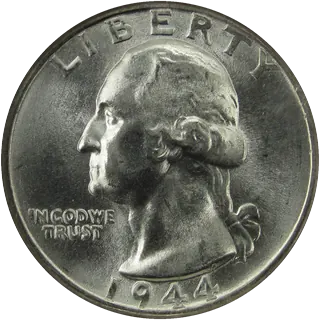
1964 quarter
Yes. 90% silver.
Silver inside
0.1808 oz
Worth as silver
$9.77
Times face value
39×
Every quarter dated 1964 or earlier is 90% silver, whatever its mint mark. Spent, it buys $0.25 of anything. Melted, it is worth about $9.77. A parking meter only sees the face value: feed it this coin and you just paid 39 times the rate.
Check it: look at the edge. Solid silver all the way round means silver; a copper stripe means it is not.
Coin photo: Brandon Grossardt, CC BY-SA 3.0, via Wikimedia Commons. Shows the design, not your exact date.
How this is worked out
- 1. The coin, the year and the mint mark decide the alloy, from the rules in the table below. Nothing is guessed from a photograph.
- 2. Silver inside = the coin’s standard weight × its silver fraction ÷ 31.1035 grams to the troy ounce. A pre-1965 quarter: 6.25 g × 0.90 ÷ 31.1035 = 0.1808 oz.
- 3. Worth as silver = ounces × the spot silver price, currently $54.05 an ounce (Oct 24, 2026).
That is melt value at full mint weight. Worn coins hold a little less, and dealers buy below spot. Scarce dates and proofs can be worth far more to a collector than their metal; that is a question for a dealer, and this page does not price it.
Data: the silver price comes from gold-api.com, refreshed about every 20 minutes, with a stored fallback of $54.05 an ounce (October 24, 2026) when the feed does not answer. Coin weights, alloys and dates are listed under “Where these rules come from” below. Data updated October 2026.
Worked examples
Melt value at the stored silver price of $54.05 an ounce (October 24, 2026).
- A 1964 quarter holds 0.1808 oz of silver, worth $9.77, or 39 times its face value.
- A roll of 90% dimes (50 dimes, $5 face) holds 3.617 oz, worth about $196. Each dime is 0.0723 oz, $3.91.
- A 1964 Kennedy half dollar holds 0.3617 oz, worth $19.55. A 1967 half, at 40% silver, holds 0.1479 oz, worth $7.99.
- A 1943-P war nickel holds 0.0563 oz, worth $3.04, which is 61 times what it says on it.
What years are US coins silver?
One date does most of the work: 1964. Until then, the dime, the quarter and the half dollar were 90% silver and 10% copper, and had been, give or take a fraction of a percent, since the 1830s. In 1965 silver became too valuable to spend, and the Coinage Act of 1965 replaced it with a sandwich of copper-nickel over copper. The coins kept their size, their designs and their face values. They just stopped being worth anything apart from the promise printed on them.
| Coin | Silver years | Silver | Ounces |
|---|---|---|---|
| Penny | Never | 0% | 0 |
| Nickel | 1942–1945, large mint mark above Monticello | 35% | 0.0563 |
| Dime | 1964 and earlier | 90% | 0.0723 |
| Quarter | 1964 and earlier | 90% | 0.1808 |
| Half dollar | 1964 and earlier | 90% | 0.3617 |
| Half dollar | 1965–1970 | 40% | 0.1479 |
| Dollar | 1935 and earlier (Morgan, Peace) | 90% | 0.7735 |
| Eisenhower dollar | 1971–1976, S collector issues only | 40% | 0.3162 |
Ounces are troy ounces of pure silver at full mint weight.
The exceptions that catch people out
The half dollar did not go quietly. The 1964 Kennedy half is 90% silver. From 1965 to 1970 the half kept 40%, as a sort of farewell tour, and only in 1971 did it join the dime and quarter in copper-nickel. A 1967 half in a drawer is silver; a 1967 quarter beside it is not. The guide to Kennedy halves by year shows how to tell the three kinds apart by the edge.
The war nickel. In 1942 the Mint needed nickel for the war, so from October of that year until the end of 1945 the five-cent piece was 56% copper, 35% silver and 9% manganese. To keep them apart for the eventual melt, the Mint put a large mint mark above Monticello’s dome — including, for the first time on any US coin, a P for Philadelphia. A 1942 nickel with no letter above the dome, or with a small D beside the building, is the ordinary kind.
The S. San Francisco has struck coins for collectors in two metals at once. The 1776–1976 Bicentennial quarter, half and dollar came in 40% silver sets as well as copper-nickel ones; Eisenhower dollars with an S were 40% silver from 1971 to 1974, with copper-nickel S proofs alongside them from 1973; and since 1992 the Mint has sold silver proof sets beside the ordinary proofs, in 90% silver until 2018 and 99.9% from 2019. The letter alone cannot tell you which you have. The scale and the edge can.
The years that do not exist. No quarters, halves or dollars are dated 1975: they all carry the double date 1776–1976. No quarters were struck in 1933. And no silver dollars carry dates from 1936 to 1970, so a “1950 silver dollar” is, at best, a medal.
How to tell if a coin is silver without reading the date
Look at the edge. A silver coin is the same metal all the way through, so its rim is one solid color. A modern dime, quarter or half is a sandwich, and the copper filling shows as a thin orange stripe. Stand a handful on edge and the silver ones announce themselves in about thirty seconds.
Weigh it. Silver is denser, so for the same size the silver coin is heavier. A kitchen scale that reads to a hundredth of a gram settles every case except the war nickel, which weighs the same 5 grams either way and has to be judged by its mint mark.
| Coin | Silver | Copper-nickel |
|---|---|---|
| Dime | 2.50 g | 2.27 g |
| Quarter | 6.25 g | 5.67 g |
| Bicentennial quarter, S | 5.75 g (40%) | 5.67 g |
| Half dollar | 12.50 g (90%), 11.50 g (40%) | 11.34 g |
| Eisenhower dollar | 24.59 g (40%) | 22.68 g |
Found some? The junk silver calculator adds up a whole jar by face value or coin by coin, and the 1964 quarter value page shows what those quarters bought when they were new.
Questions people actually ask
What years are quarters silver?
Every US quarter dated 1964 or earlier is 90% silver and holds 0.1808 troy ounces. Quarters dated 1965 or later that you find in change are copper-nickel. The exceptions are collector coins with an S mint mark: 40% silver Bicentennial quarters dated 1776–1976, and silver proofs from 1992 on.
What years are dimes silver?
Dimes dated 1964 and earlier are 90% silver, with 0.0723 troy ounces each. That covers every Roosevelt dime from 1946 to 1964, every Mercury dime and every Barber dime. From 1965 the circulating dime is copper-nickel; only silver proof dimes with an S, made from 1992, contain silver.
Are 1965 quarters silver?
No. The Coinage Act of 1965 made the quarter copper-nickel starting with 1965-dated coins. A handful of 1965 quarters were struck on leftover silver blanks by mistake. They are rare, and they weigh 6.25 grams instead of 5.67, so a scale that reads to a hundredth of a gram can find one.
Which nickels are silver?
Only the war nickels: some 1942 and all 1943 to 1945 nickels were made of 56% copper, 35% silver and 9% manganese, about 0.0563 troy ounces of silver each. They have a large P, D or S above Monticello on the back. A 1942 nickel with no letter there, or with a small D beside the building, is not silver.
Are Kennedy half dollars silver?
The 1964 Kennedy half is 90% silver, with 0.3617 troy ounces. Halves dated 1965 to 1970 are 40% silver, with 0.1479 ounces. From 1971 the circulating half is copper-nickel, apart from 40% silver Bicentennial halves with an S and silver proofs with an S from 1992.
Is a 1976 quarter silver?
Not if it came out of your change. Quarters dated 1776–1976 were made in copper-nickel for circulation and in 40% silver only for collector sets, all with an S mint mark. A silver one weighs about 5.75 grams against 5.67 for copper-nickel, and has no copper stripe on its edge.
Are Eisenhower dollars silver?
Only some. Eisenhower dollars from circulation, 1971 to 1978, are copper-nickel. The ones struck at San Francisco for collectors from 1971 to 1976, with an S mint mark, are 40% silver and hold 0.3162 troy ounces. The Mint also made copper-nickel S proofs from 1973, so weigh it: 24.59 grams is silver.
Are pennies silver?
No US cent has ever contained silver. The 1943 penny that looks silver is zinc-coated steel, made because copper was needed for the war; a magnet will pick it up. It is a collectible, but it holds no silver at all.
How can you tell if a coin is silver?
Read the date first: dimes, quarters and halves from 1964 or earlier are silver. Then check the edge: silver coins are one solid color all the way round, while copper-nickel coins show a copper stripe. For S-marked collector coins, weigh them, because silver versions are heavier.
Where these rules come from
- Coinage Act of 1965, Public Law 89-81: silver removed from the dime and quarter, the half dollar cut to 40%.
- Jefferson nickel (Wikipedia, checked Oct 4, 2026): the 56/35/9 wartime alloy from October 1942, the large mint mark above Monticello, the first P.
- Washington quarter (Wikipedia, checked Oct 4, 2026): no 1933 or 1975-dated quarters, mint-mark positions, the 1992 and 2019 silver proofs.
- Eisenhower dollar (Wikipedia, checked Oct 4, 2026): 40% silver S issues, circulation strikes copper-nickel.
- APMEX on the Bicentennial issues (checked Oct 4, 2026): 40% silver quarter about 5.75 g against 5.67 g clad.
- Coin weights and fineness: assets/js/series.js, each checked against Numista and the US Mint; spot price as labeled on the card.