Stacker Guides · Buying
What Is Junk Silver? Which Coins It Includes and What to Pay
Pre-1965 dimes, quarters and halves, sold by the dollar and worth about forty times face. Which coins count, how much silver is in a dollar, a pound or a 55-pound bag, and how to tell a fair price from a dealer's boat payment.
By Joel Perkes · · 7 min read
Somewhere in America there is a coffee can full of dimes that nobody has spent since 1964. It is called junk silver, which is a strange name for something worth about forty times what it says on it. The junk part is a compliment, sort of. It means no collector wants these coins for their rarity, so they trade on one thing only: the silver inside.
So, what is junk silver? It is ordinary US coinage that contains silver: dimes, quarters and half dollars dated 1964 or earlier, which are 90% silver, plus 1965 to 1970 Kennedy halves at 40% and 1942 to 1945 war nickels at 35%. It is bought and sold by face value, and every $1 of face value in 90% coins holds about 0.715 troy ounces of silver once normal wear is allowed for. What you should pay is that silver at the day’s spot price plus a small premium, and in 2026 the cheapest dealers have often sold it within a few percent of melt value.
Which coins are junk silver?
The dividing line is a law. The Coinage Act of 1965, signed on July 23, 1965, took the silver out of the dime and the quarter and cut the half dollar to 40%. Silver had become worth more as metal than as money, and when that happens people keep the good coins and spend the others, which is Gresham’s law working exactly as described.
| Coin | Dates | Silver | Silver per $1 face |
|---|---|---|---|
| Dimes, quarters, half dollars | 1964 and earlier | 90% | 0.7234 oz new, 0.715 oz traded |
| Kennedy half dollars | 1965 to 1970 | 40% | 0.2958 oz |
| War nickels | 1942 to 1945 | 35% | 1.125 oz |
| Morgan and Peace dollars | 1935 and earlier | 90% | 0.7735 oz |
Three things in that table surprise people. The first is that a 1964 Kennedy half is 90% silver like any other pre-1965 coin; only the 1965 to 1970 halves are 40%. The second is that the humble war nickel holds the most silver per dollar of face value, because twenty of them make a dollar and each one carries 1.75 grams of silver. The third is that Morgan and Peace dollars usually aren’t sold as junk at all. Collectors like them, so dealers list them separately and price them higher than the silver alone; the Morgan dollar guide explains how much higher.
War nickels hold the most silver per dollar of face value
Troy ounces of silver in $1 of face value, by coin.
Checking a coin takes a few seconds: read the date, then look at the edge. A silver coin’s edge is solid silver-gray; a clad coin shows a copper stripe. The Is my coin silver? checker works through any date and denomination, and the real silver guide covers the tests for a coin you aren’t sure about.
How much silver is in $1 of face value?
A pre-1965 dime weighs 2.5 grams, a quarter 6.25 grams and a half dollar 12.5 grams, all 90% silver. Ten dimes, four quarters and two halves therefore all weigh 25 grams and hold 22.5 grams of silver, which is 0.7234 troy ounces. The mint designed it that way, and it is why nobody counts junk silver by coin. A dollar is a dollar is 0.7234 ounces, whatever mix is in the bag.
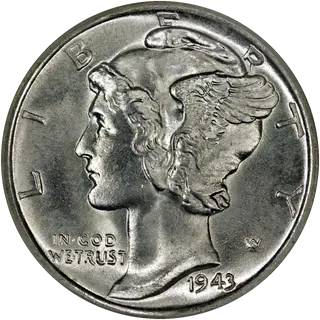
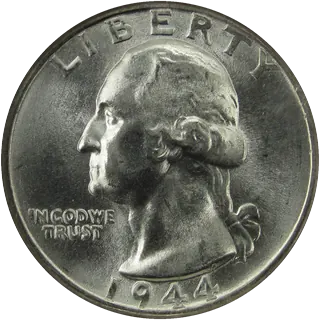
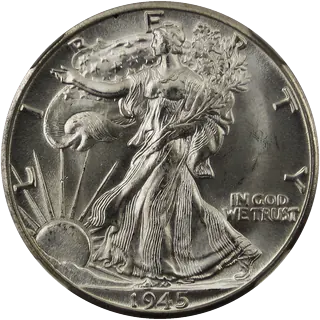
The trade rounds that down to 0.715 ounces per $1 face, about 1.2% less, to allow for decades of pockets, vending machines and cash registers wearing metal off. So the melt value of junk silver is:
face value × 0.715 × silver price
A standard $1,000 face bag holds 715 troy ounces of silver and weighs about 55 pounds, because it contains roughly 10,000 dimes, 4,000 quarters or 2,000 halves. Half bags ($500 face) and quarter bags ($250 face) are common too, and smaller buyers buy by the roll or by $1 or $10 of face. The junk silver calculator does the arithmetic at the day’s price for any face value.
Into the weeds: 40% halves and war nickels
A 1965 to 1970 Kennedy half weighs 11.5 grams at 40% silver, so it holds 4.6 grams, or 0.1479 troy ounces; two of them make $1 face and 0.2958 ounces. A war nickel weighs 5 grams at 35%, so it holds 1.75 grams, or 0.0563 ounces, and twenty of them make 1.125 ounces per $1 face. Dealers sell both separately from 90% coins and price them by the silver they contain. Keep them in their own piles, because a mixed jar can’t be valued by face value.
Can you value junk silver by weight?
Yes, and for a big jar it is faster than counting. Weigh the coins, subtract the jar, and multiply by the silver fraction. A pound of 90% coins holds about 13.1 troy ounces of silver. That figure doesn’t depend on wear: a worn coin lost silver and copper in the same proportion, so its weight still tells you its silver. Wear only changes how much face value a pound represents, which works out at about $18.36 of worn coins.
The same pound holds about 5.8 ounces if it is 40% halves and about 5.1 ounces if it is war nickels, which is the best reason to sort before you weigh. The calculator’s “By weight” mode takes pounds, ounces, kilograms or grams, and a kitchen scale is accurate enough.
What should you pay for junk silver?
Dealers quote junk silver in one of three ways: a price per $1 of face value, a multiple of face value (“42 times face”), or a premium over spot. All three convert to the one number that matters, the price per ounce of silver:
price per $1 face ÷ 0.715 = price per ounce
Take a made-up example with silver at $60 an ounce. The melt value of $1 face is 0.715 × $60, or $42.90. A dealer asking $45 per $1 face is charging $62.94 an ounce, which is 4.9% over melt. Now you can compare that with a Silver Eagle, a bar or a round on equal terms.
For a sense of the range, the price-comparison site FindBullionPrices tracks the lowest dealer price each day. For $1 face of 90% half dollars, that lowest price averaged between 2.42% below and 2.66% above melt in each month from July 2025 to early October 2026. Over the same stretch, the lowest price for a 2026 Silver Eagle averaged 8.73% over spot in July 2026. Those are the cheapest prices online, not what a local shop charges, and shipping is extra. Premiums also swing: during the silver rush of 2021 and 2022, the same site records Eagle premiums of more than 50%.
A few things push the price per ounce up. Small lots cost more than bags. Coins in better condition sometimes cost more, which is odd, since a junk buyer is paying for silver and a worn coin’s silver is already allowed for in the 0.715. And anything sold as “rare”, “key date” or “graded” has left junk territory and is priced as a collectible. The premium calculator turns any quote into a premium over spot and adds up the round-trip cost of buying and selling.
Why do people buy junk silver?
The usual reasons are that the coins come in small pieces, they are instantly recognizable as US money, and in bulk they often cost less per ounce than one-ounce coins. The coins are also a short history lesson: each one was spendable money that turned into a commodity because the metal outgrew the number stamped on it.
The bear case is fair to state. Junk silver is bulky; a bag is heavy and holds less silver per pound than pure bullion, since 10% of every coin is copper. Dealers’ buy prices for it can fall below melt when lots of people are selling. And in the US it is taxed like any other silver, as a collectible: the tax guide has the rates. Many stackers still repeat an old rule that dealers report $1,000 face of 90% coins to the IRS; that list is out of date, and the dealer reporting guide explains what replaced it.
Is there junk silver outside the US?
Yes, and the cutoff dates differ by country. The calculator’s coin counter covers all of these; the “By weight” mode is US only, because the face value rule is an American one.
| Country | Silver coins | Worth knowing |
|---|---|---|
| United Kingdom | 92.5% to 1919; 50% from 1920 to 1946 | 1920 is mixed: some coins are 92.5%, some 50% |
| Canada | 92.5% to 1919; 80% from 1920 to 1967; 50% dimes and quarters in 1967 and 1968 | 1967 dimes and quarters were struck in both alloys and look the same |
| Australia | 92.5% to the mid-1940s; 50% from 1946 to 1963 (threepence to 1964) | The 1966 round 50-cent coin is 80% silver |
The British call theirs pre-47 silver and the Australians say pre-46. It is the same idea in a different accent: change that outlived the money it was minted for.
What to do with the coffee can
Sort it, weigh or count it, and put a number on it before anyone makes you an offer. The coins have been worth more than their face for about sixty years. They can wait another ten minutes while you do the arithmetic.
Sources
- Coinage Act of 1965, signed July 23, 1965: silver removed from the dime and quarter, the half dollar cut to 40%: Wikipedia, Coinage Act of 1965. Kennedy halves at 40% from 1965 to 1970: Wikipedia, Kennedy half dollar.
- War nickels, 5 grams at 35% silver, 1942 to 1945, mint mark above Monticello: Wikipedia, Jefferson nickel.
- Coin weights and fineness (dime 2.5 g, quarter 6.25 g, half dollar 12.5 g, Kennedy half 11.5 g, Morgan and Peace dollars 26.73 g), the trade’s 0.715 ounces per $1 face, and the UK, Canadian and Australian alloys and dates: the coin table on this site’s junk silver calculator, with its sources.
- Premiums: lowest tracked dealer price for $1 face of 90% half dollars, monthly averages July 2025 to October 2026, FindBullionPrices; 2026 American Silver Eagle, July 2026 average and the 2021–2022 note, FindBullionPrices. Both measure premium as the lowest dealer price over the spot value of the metal.
Figures read October 17, 2026. Worked out by us from the coin weights: 0.7234 ounces per $1 face at mint weight; 1.125 ounces per $1 face in war nickels and 0.2958 in 40% halves; 715 ounces and about 55 pounds in a $1,000 bag; 13.1 ounces of silver and about $18.36 of worn face value in a pound of 90% coins; 5.8 and 5.1 ounces in a pound of 40% halves and war nickels; and the $60 example ($42.90 melt, $62.94 an ounce, 4.9% over melt).
Questions people actually ask
What is junk silver?
Junk silver is ordinary US coinage that contains silver: dimes, quarters and half dollars dated 1964 or earlier, which are 90% silver, plus 1965 to 1970 Kennedy halves at 40% and 1942 to 1945 war nickels at 35%. It is called junk because the coins have no collector value beyond their silver.
What years are junk silver coins?
Dimes, quarters and half dollars dated 1964 or earlier are 90% silver. Kennedy half dollars dated 1965 to 1970 are 40% silver. Jefferson nickels dated 1942 to 1945 with a large mint mark above Monticello are 35% silver.
How much silver is in $1 face value of junk silver?
A dollar of face value in 90% dimes, quarters or halves holds 0.7234 troy ounces of silver when new. Dealers count worn coins at 0.715 ounces per $1 face, about 1.2% less, to allow for wear.
How do you calculate the melt value of junk silver?
Multiply the face value by 0.715 and by the silver price per ounce. At $60 silver, $1 face is worth $42.90 in silver, and a $1,000 face bag holds 715 ounces.
How much does a $1,000 face bag of junk silver weigh?
About 55 pounds. It holds roughly 10,000 dimes, 4,000 quarters or 2,000 half dollars, and 715 troy ounces of silver.
How much silver is in a pound of junk silver?
About 13.1 troy ounces in a pound of 90% coins, whether they are worn or not. A pound of 40% Kennedy halves holds about 5.8 ounces and a pound of war nickels about 5.1 ounces.
What is a good price for junk silver?
Divide the price per $1 face by 0.715 to get the price per ounce, then compare it with the silver price. From July 2025 to October 2026, the lowest dealer price tracked by FindBullionPrices for $1 face of 90% halves averaged between 2.42% below and 2.66% above melt value each month. Local shops and small lots usually cost more.
Are 1964 Kennedy half dollars silver?
Yes. 1964 Kennedy halves are 90% silver, like every other pre-1965 dime, quarter and half dollar. Kennedy halves dated 1965 to 1970 are 40% silver, and later ones contain none, apart from special collector issues.
Do other countries have junk silver?
Yes. British coins are 92.5% silver to 1919 and 50% from 1920 to 1946. Canadian coins are 92.5% to 1919 and 80% from 1920 to 1967. Australian coins are sterling to the mid-1940s and 50% from 1946 to 1963, and the 1966 round 50-cent coin is 80% silver.